The world is what it is. What holds us back from accepting it as it is? Why do we want to bend it based on our perception? Why do we create frictions between us? And why can’t we be silent, even for a moment? Peace eludes us, and we keep running to find happiness. This blog is my attempt to share thoughts and ideas about the concept of a beginner’s mind – a mind that is full of attention and curiosity and tries to look at the world as it is.
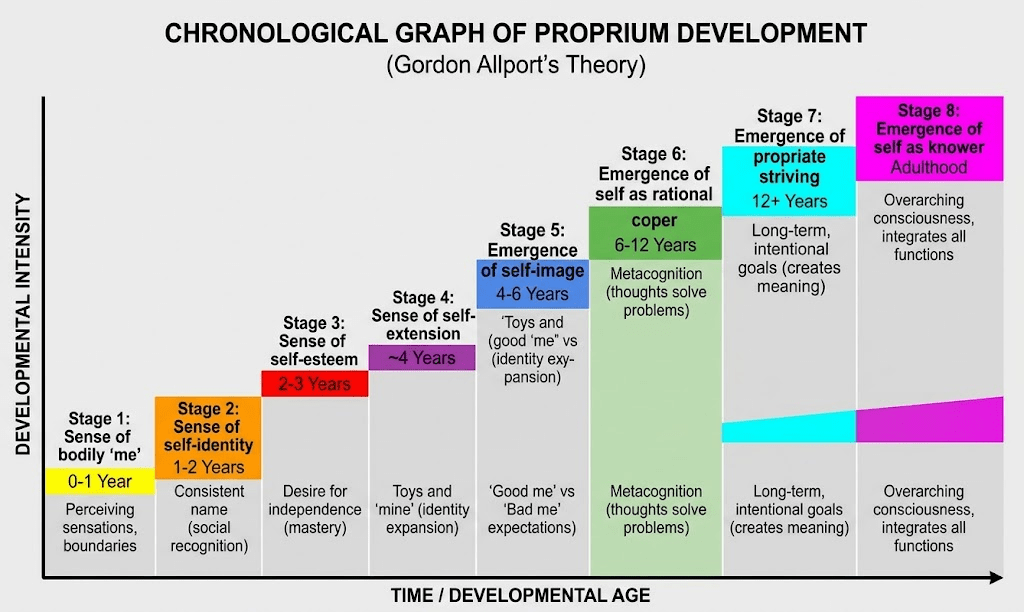
Sitting with coffee, I wonder how to proceed with this three-part series on “The Old Mind.” I am struggling with the topic. I am distracted, and while browsing the internet for research, I stumble on an old article about the development of the “felt self” — the core aspects of personality that make up the ego. The author argued that, rather than being a fixed entity, the ego develops through seven distinct stages, and finally reaches an eighth — self-as knower, which maps to the eastern concept of “the witness.” That made me curious.
This idea came from Gordon Allport, an American psychologist who spent much of his life studying personality and the development of the self. Allport called this developing self the “proprium,” and described it as unfolding through seven stages , from early infancy into adolescence. The development culminates with eighth one – self as the knower. I call it the aggregated ego – the life filter through which we see the world. This creates the Maya.
I think the self — the ego — manifests us in the world. Our thoughts, values, actions, and reactions all go through the filter of our “self.” That is why the same event or object has a different projection in our mind. One person sees a homeless man as a nuisance; another sees a human being, suffering and struggling. These self-filters bend reality. The self becomes our life, and creates a reality we all believe in.
I got more curious, and wanted to know if this development concept had any correlated concept in eastern philosophy. To my surprise, Allport’s stages of proprium (self/ego) development map directly onto the psychological processes that Buddhism describes as the gradual construction of the illusory self (atta).
The key difference is the approach towards the self. While Allport views these stages as essential milestones towards a mature personality, Buddhism categorizes them as cumulative layers of mental fabrication (sankharas) and clinging (upadana). Buddhist vipassana meditation works systematically to observe each of these layers, to reach a wisdom about nature of the self – impermanent (anicca), unsatisfaction (dukkha), and non-self (anatta).
Both concepts call out the development of self — one towards building a permanent self, the other towards constructing an impermanent mental assembly that keeps changing, and bringing us unhappiness. A true liberation comes from recognizing its fundamental emptiness (sunyata), rather than solidifying personal identity.
So where are we left? What can we do?
Zen philosophy calls out a practical approach to this paradox of illusory self versus permanent self. The concept is Beginner’s Mind (shoshin) — the mind which comes when we are born. It acts as a reset button, one that can systematically dismantle the illusory self and reveal unconditional awareness. While the ego operates as an expert — filtering reality through past conditioning, fixed concepts, and self-preservation — the Beginner’s Mind approaches every moment without preconception, directly disrupting the machinery of ego construction.
So, what can we do to develop the Beginner’s Mind?
1. Bare sensory observation. Rest attention on incoming sensory data, without applying any labels.
2. Shikantaza (just sitting) — with no focus, no goals. Let the thoughts come. Watch them and slowly come back to bare presence.
There are many others. But I have seen these two practices work wonders. As we grow old, we should slow down and try to simply do an activity, with full presence. That will probably transform us fundamentally. The silence can evolve into peace. This potential is worth trying.


Leave a Reply